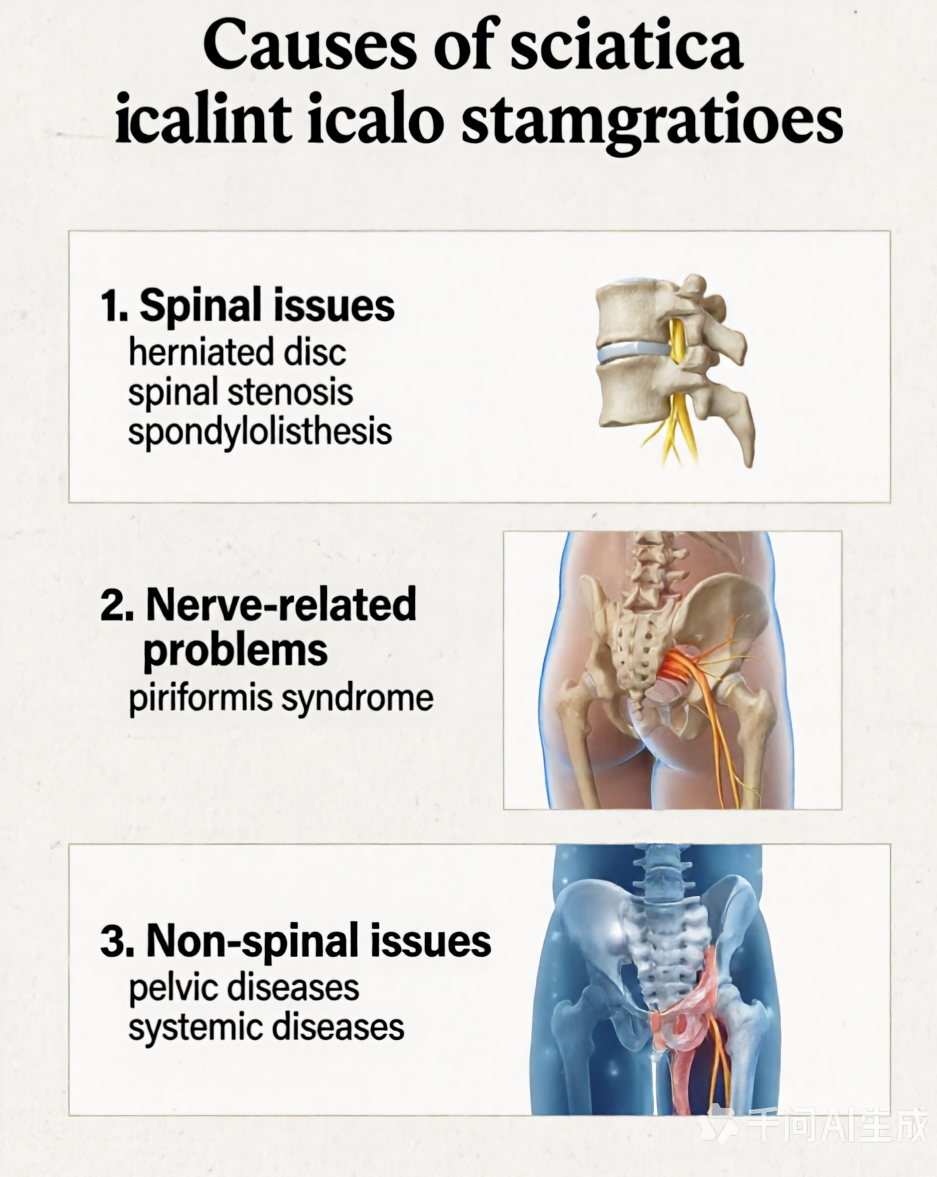
In the vast majority of cases, sciatica is caused by nerve compression resulting from lumbar spine disorders, with a herniated lumbar disc being the most common cause. In a small number of cases, it is associated with inflammation of the nerve itself or pelvic abnormalities.
Spinal Issues (Most Common)
Herniated Lumbar Disc: This is the primary cause of sciatica. When the cartilage disc connecting the vertebrae is compressed and bulges backward, it directly compresses the sciatic nerve root, causing pain.
Lumbar Spinal Stenosis and Bone Spurs: As people age, the spine undergoes degenerative changes, leading to the growth of excess bone (commonly known as bone spurs) or a narrowing of the spinal canal, which compresses the nerves. This condition is more common in people over the age of 50.
Lumbar Spondylolisthesis: When a lumbar vertebra slips forward relative to the vertebra below it, it can also compress the nerve.
Compression of the Nerve Itself or Localized Compression
Primary Sciatica: This condition is relatively rare; usually, no specific point of compression can be identified. It may be related to exposure to cold, a cold, or an infection in another part of the body (such as tonsillitis) that affects the nerve’s outer membrane and causes inflammation.
Piriformis Syndrome: As the sciatic nerve passes through the buttocks, it runs alongside the piriformis muscle. If this muscle becomes tight and spasms due to overuse or exposure to cold, it can clamp down on the nerve like a pair of pliers, causing pain.
Non-spinal Causes
Pelvic Disorders: Tumors or inflammation within the pelvis, or an enlarged uterus during pregnancy, can compress the sciatic nerve pathway.
Systemic Diseases: In rare cases, systemic metabolic disorders such as diabetes and gout can also lead to secondary neuropathy.
Although sciatica is uncomfortable, it is typically a self-limiting condition, and time is often the best “remedy.” Once the cause is identified, resuming activity as soon as possible—as long as the pain is tolerable—and avoiding prolonged bed rest usually leads to relief.
Faustum Group
next: >period

509, 5/F THE CLOUD 111 TUNG CHAU ST TAI KOK TSUI HONG KONG


